Azure Firewall
What it is
Azure Firewall is a managed, stateful network firewall service for Azure workloads. It can inspect both traffic entering or leaving a network (north-south) and traffic moving between network segments (east-west), then allow or deny it according to configured rules.
Why it exists
Network security groups protect individual subnets or network interfaces. Azure Firewall gives a team a central inspection point and shared rule policy when traffic must be routed through it. It can complement NSGs; the two do not replace one another automatically.
Key ideas
- Network rules use IP addresses, protocols, and ports. Application rules use fully qualified domain names (FQDNs) for supported application traffic. NAT rules can map inbound traffic to a private destination.
- A Firewall Policy holds reusable rule collections and configuration that can be applied to one or more firewalls. It makes shared governance clearer than maintaining unrelated rules in each deployment.
- Azure Firewall has Basic, Standard, and Premium SKUs. Standard offers L3–L7 filtering and Microsoft threat-intelligence feeds. Premium adds capabilities such as signature-based intrusion detection and prevention. Select features from the current SKU documentation rather than assuming every firewall includes Premium inspection.
- User-defined routes can send selected traffic to the firewall for inspection. This is a routing design choice: a rule cannot inspect traffic that never reaches the firewall.
- Azure Firewall can run in virtual-network and Virtual WAN secure-hub designs. Its exact subnet, public-IP, availability-zone, and capacity configuration depends on the chosen deployment design and SKU.
How it fits
[VM/app] ──selected UDR──► [Azure Firewall] ──► [allowed destination]
                              │  Application / network / NAT rules
                              ▼
                           logging and alerting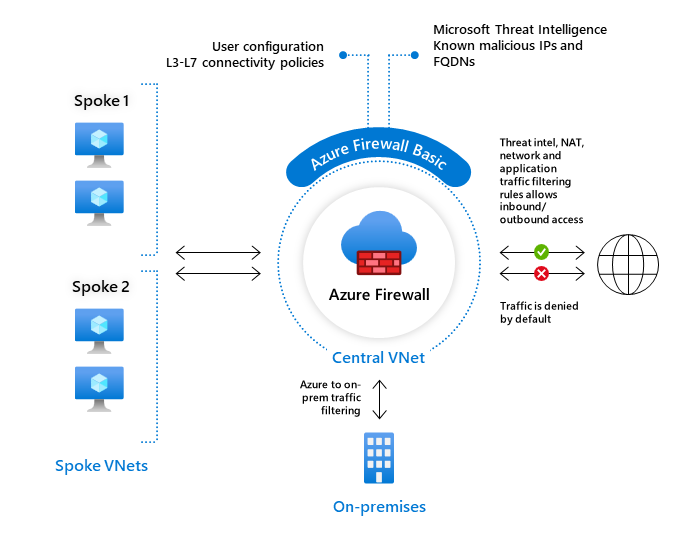
Diagrams courtesy of Microsoft Learn / Azure docs: firewall/overview
Northwind example
Maya routes Northwind’s application subnet outbound traffic through Azure Firewall. An application rule permits the ordering service to reach only its approved payment-provider FQDN, while network rules control other permitted IP-and-port paths. The team reviews firewall logs when checkout fails. It does not assume the firewall can protect a workload that has a direct route around it, or that an allow rule proves the remote service is safe.
Azure Firewall, NSG, and WAF
| Service | Primary boundary |
|---|---|
| Azure Firewall | Central network and application traffic inspection and control. |
| [[nsg | Network security group]] |
| Web Application Firewall | HTTP(S) web-attack protection for supported web entry points. |
Use the services according to traffic path and threat model. They can work together.
Common confusion
- Azure Firewall is stateful; it does not make NSGs “stateless.” NSGs are also stateful, but they operate at a different scope and feature set.
- Threat intelligence and advanced inspection do not remove the need for least privilege, patching, identity controls, and application security.
- A firewall rule governs network traffic, not whether a caller is authorized to read a specific order or customer record.
Related
Home · nsg · route-table · virtual-wan · ddos-protection · vnet
Sources and re-audit
- Microsoft Learn — What is Azure Firewall?, checked 2026-09-16.