Azure region
What it is
An Azure region is a geographic area containing one or more datacenters connected through Azure’s network. When you create a regional service, you choose a region such as eastus, westeurope, or uksouth. That choice affects the service’s location, what features are available, latency to users, pricing, and sometimes legal or organizational requirements.
Why it exists
You choose a region to place a workload near users or connected systems, to meet data-residency needs, and to use services available there. One subscription can contain workloads in many regions. Not every Azure service is regional; some are global, and service availability differs by region.
Region, zone, geography, and pair
- A zone is a separate physical-fault boundary inside a zone-enabled region. A region is not itself a zone.
- A geography is a market or area containing one or more regions and can matter for residency and compliance commitments.
- Many regions have a region pair, but a pair is not an automatic disaster-recovery solution. Cross-region replication, failover, backups, and the application’s behavior must be configured service by service.
- A sovereign cloud is a separately operated cloud environment for particular regulatory or government needs; it is not merely another public-cloud region.
How it fits (diagram)
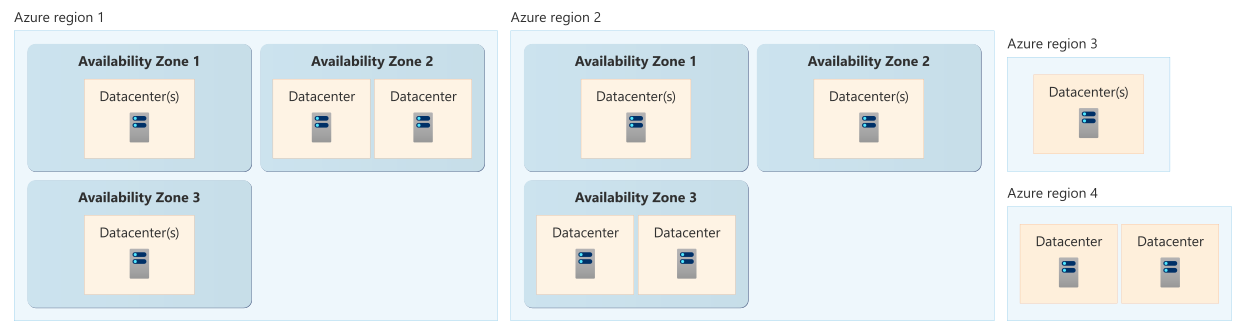
Diagrams courtesy of Microsoft Learn / Azure docs: reliability/availability-zones-overview
Northwind example
Northwind chooses a region near its customers and warehouse systems after checking that App Service, storage, and its required reliability options are supported there. Its production subscription may also contain monitoring or recovery resources elsewhere. If Northwind later needs to serve another continent or survive a full regional outage, it designs and tests a multi-region pattern; selecting a region pair alone does not copy its application.
Common confusion
- A resource-group location is not the same as the location of every resource inside it.
- A region can contain zones, but a region with zones does not automatically make every resource zone-resilient.
- Changing a workload’s region is usually a service-specific move or redeployment, not a simple rename. Check the supported migration path before planning it.
Related
availability-zones · subscription · resource-group · northwind-traders-case-study
📘 Sources: Microsoft Learn — Azure regions and geographies and What are availability zones?, checked 2026-09-16.